Legal Explainer

What is Passing Off Under Trademark Law?
a day ago
S PavithraBookmark

What is Salmond’s Pigeon Hole Theory?
Salmond’s "Pigeon Hole Theory" suggests that the Law of Torts is a collection of specific, closed categories.
He argued that for a person to be held liable, their wrong must fit into a pre-defined "pigeon hole." Under this rigid view, if an injury does not match a labeled category, the victim is left without a remedy.
Salmond believed there was no general "Law of Tort," only a "Law of Torts." In contrast, modern courts prefer an expansive approach, allowing the law to grow.
While Salmond’s theory offers legal certainty, it is often criticized for being too narrow to address new, evolving social harms.
8 days ago
AnvishaaBookmark

What is the tort of Negligence?
In the Law of Torts, negligence is a failure to exercise the level of care that a "reasonable person" would have used in a similar situation, resulting in unintended harm to another.
Unlike intentional torts like trespass, negligence focuses on carelessness rather than the desire to cause injury.
It is the most common grounds for lawsuits today, covering everything from car accidents to medical malpractice.
To prove negligence, three elements must coexist: a legal duty of care owed to the victim, a breach of that duty through action or inaction, and consequential damage or injury that was a direct result of that breach.
8 days ago
AnvishaaBookmark

What is the Doctrine of Strict Liability?
The Doctrine of Strict Liability holds a person legally responsible for damages or injuries, even if they were not at fault or did not act negligently.
Established in the landmark English case Rylands v. Fletcher (1868), this rule states that if someone brings a dangerous substance onto their land that is likely to cause mischief and if it escapes, they are "strictly" liable for any resulting damage, regardless of how careful they were.
However, this doctrine is not absolute; it allows for specific defenses, such as "Act of God" or the "Plaintiff’s own fault" to avoid liability.
8 days ago
AnvishaaBookmark
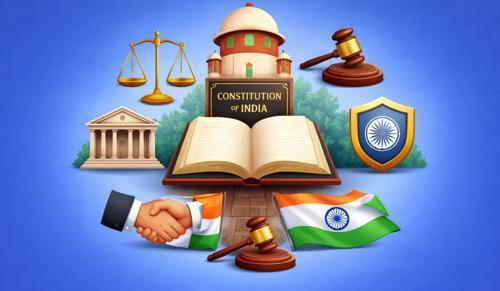
What is 'Constitutional Morality' and 'Transformative Constitutionalism'?
Constitutional Morality and Transformative Constitutionalism serve as judicial engines for social evolution in India.
Constitutional Morality prioritizes the spirit of the Constitution, anchored in liberty and equality, over majoritarian or traditional "public morality," ensuring that individual rights are protected against societal prejudice.
Complementing this, Transformative Constitutionalism views the Constitution as a dynamic tool intended to dismantle historical hierarchies and transform India into a truly egalitarian society.
However, they remain subjects of intense debate, with critics arguing that their inherent subjectivity allows judges to override established religious traditions and the literal text of the law.
15 days ago
AnvishaaBookmark

What is Judicial Recusal?
Judicial recusal occurs when a judge steps down from a case to prevent a conflict of interest, ensuring that justice is both done and seen to be done.
Rooted in the principle of nemo debet esse judex in propria causa, it safeguards against bias arising from financial interests, personal connections, or prior involvement.
While a judge may recuse suo motu, litigants can also request it. However, the Supreme Court cautions against "forum shopping," emphasizing a judge's "duty to sit" unless a real danger of bias exists.
Ultimately, the decision rests on the judge's conscience to maintain public confidence in an impartial judiciary.
16 days ago
AnvishaaBookmark

Who are Shourya Didis?
“Shourya Didis” are women volunteers/officially designated functionaries associated with State women and child welfare mechanisms, tasked with providing support, guidance, and monitoring in sensitive cases involving women.
Courts, particularly in habeas corpus or protection matters, may direct their involvement to ensure the safety and well-being of adult women exercising personal choice.
Their role aligns with constitutional guarantees under Article 21 and Directive Principles like Articles 38 and 39, promoting dignity and welfare.
They function similarly to support persons under protective frameworks, ensuring that an individual’s autonomy is respected while safeguarding against coercion or exploitation.
16 days ago
S PavithraBookmark

What is the Right to Digital Inheritance?
Digital Heritage refers to the collection of digital assets: cryptocurrency, social media profiles, and monetized content, left behind after death.
While Indian succession laws like the Hindu Succession Act, 1956, are largely silent on digital property, the Digital Personal Data Protection (DPDP) Act, 2023, introduced a significant "Right to Nominate." This allows individuals to designate a nominee to exercise data rights upon their death.
However, a "legal vacuum" persists: while nominees can manage data privacy, transferring ownership of financial digital assets still requires a formal Will.
Experts recommend appointing a "Digital Executor" to prevent assets from vanishing into "digital oblivion" due to restrictive platform terms.
21 days ago
AnvishaaBookmark

What is Greenwashing as per SEBI Guidelines?
Greenwashing involves making deceptive or exaggerated claims about a company’s environmental benefits to appear more "eco-friendly" than it truly is.
As of April 2026, SEBI has enforced the BRSR Core (Business Responsibility and Sustainability Reporting) framework to curb this practice. It mandates that the top 1,000 listed companies provide "reasonable assurance" and independent audits on key environmental metrics like carbon footprint and water usage.
Under the Companies Act, 2013, submitting falsified sustainability data in these mandatory filings can now be classified as fraud.
This elevates greenwashing from a mere marketing gimmick to a severe legal risk, potentially holding directors personally liable for deceptive ESG disclosures.
21 days ago
AnvishaaBookmark

What is the "3-Hour Takedown" Rule for AI Content?
The "3-Hour Takedown" Rule, introduced via the February 2026 IT Rules Amendments, mandates that intermediaries, like Instagram, X, or YouTube remove unlawful Synthetically Generated Information (SGI) within three hours of receiving a court or government order.
For highly sensitive violations, specifically non-consensual deepfake nudity, the window is even stricter at two hours.
This rule aims to curb the viral spread of deepfakes before they cause irreparable harm. Failure to comply leads to the loss of "Safe Harbour" protection under Section 79 of the IT Act.
Consequently, the platform loses its legal immunity and can be prosecuted as the original publisher of the illegal content, facing significant criminal and civil liabilities.
21 days ago
AnvishaaBookmark

What is Digital Vigilantism?
Digital vigilantism refers to people taking the law into their own hands online by exposing, accusing, or punishing someone on social media without proper verification or legal process.
This often includes sharing unverified allegations, revealing personal information, or running online campaigns that can harm a person’s reputation.
While it may be driven by a sense of justice, it can lead to serious misuse and injustice.
In India, such acts may attract legal action under Section 356 BNS (earlier Section 500 IPC), IT Act provisions (like Section 67), and laws protecting privacy and dignity under Article 21 of the Constitution.
22 days ago
S PavithraBookmark

What is the Doctrine of Transnational Issue Estoppel?
The Doctrine of Transnational Issue Estoppel serves as a critical procedural shield in international arbitration, preventing parties from relitigating specific factual or legal issues already decided by a competent "seat" court.
Unlike res judicata, which bars entire claims, issue estoppel specifically targets individual points of contention that have passed muster in a foreign jurisdiction.
For the doctrine to apply, the prior judgment must be final, on the merits, involve the same parties, and address the identical subject matter.
By enforcing these findings, Indian courts streamline the arbitration process, effectively blocking "forum shopping" where a losing party attempts to repackage failed arguments as "public policy" violations under Section 48 of the Arbitration and Conciliation Act, 1996.
23 days ago
AnvishaaBookmark

What is Criminal Misconduct under Prevention of Corruption Act, 1988?
24 days ago
S PavithraBookmark
What is a Writ of Quo Warranto?
A Writ of Quo Warranto, meaning "by what authority," is a judicial tool used to challenge a person’s right to hold a substantive public office.
Unlike most legal remedies, any citizen can file this petition, even if not personally aggrieved, to ensure public positions aren't occupied illegally.
The court conducts a "judicial audit" of the appointee's eligibility, acting as a safeguard against nepotism or the "usurpation" of power in offices created by the Constitution or a statute. The writ is issued only when the office is of a public nature and the appointment violates mandatory legal requirements.
If the court finds the appointment invalid, the office is declared vacant and holder is ousted.
26 days ago
AnvishaaBookmark

What is a "Logical Discrepancy" in Voter Rolls?
Logical Discrepancy is a technical "red flag" triggered during the Special Intensive Revision (SIR) of electoral rolls. It occurs when automated software identifies data that defies biological or administrative logic.
Common triggers include age gap anomalies or progeny clusters, where an improbable number of descendants are mapped to a single ancestor. Discrepancies also arise from poor photo quality or name transliteration errors.
The adjudication process is quasi-judicial. If flagged, an elector’s status is marked "under scrutiny" rather than deleted. As per Supreme Court directions, these lists must be displayed at local offices.
Affected voters must appear before an Electoral Registration Officer with legacy documents or ID proofs to "rectify" the error. Only after this verification is the name cleared for the Final Supplementary Roll, ensuring that "logical" errors do not result in disenfranchisement.
28 days ago
AnvishaaBookmark